
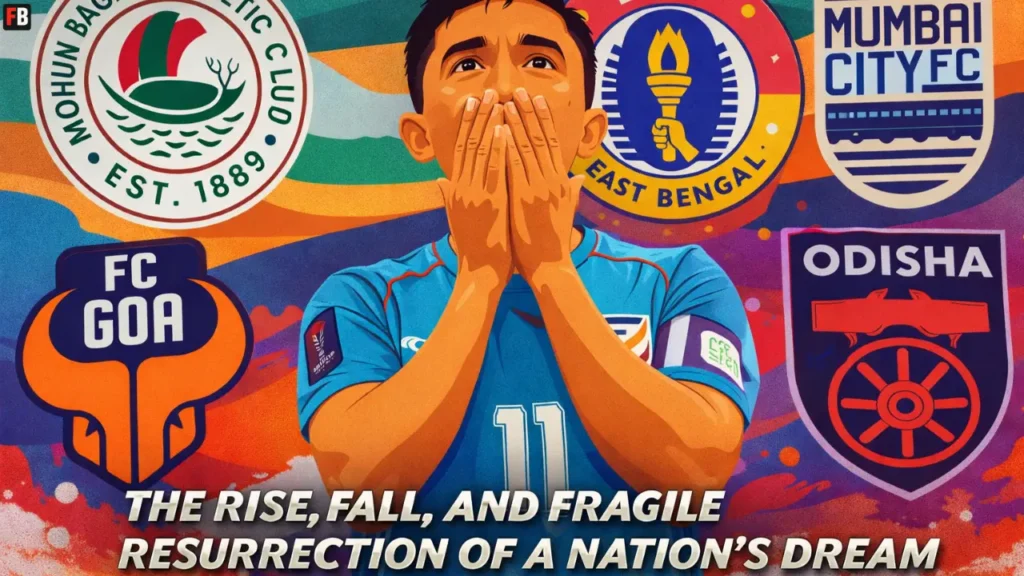
PROLOGUE: THE RISE OF A DREAMER
In late 2024, Kalyan Chaubey was crowned president of the All India Football Federation, the man who would “lift Indian football to the Asian summit.”
His inaugural speech echoed through stadiums and screens: “We shall be the force that turns stadiums into cathedrals of hope.”
Fans lit candles outside Salt Lake Stadium. Hashtags trended. Even cynics dared to believe. Little did they know, this was the calm before the storm.
ACT I: THE SLOW DESCENT INTO CHAOS (JULY 2025 – NOVEMBER 2025)
By mid ‑ 2025, the first fissures cracked open. The Indian Super League (ISL), India’s flagship competition, was slated to begin in September.
But the Master Rights Agreement (MRA), a 15‑year contract between AIFF and commercial partner Football Sports Development Limited (FSDL), expired on 8 December 2025. Negotiations stalled.
No new partner emerged. In July, FSDL publicly announced a “pause” until clarity could be reached, a euphemism for collapse.
Players wept. Sunil Chhetri, Gurpreet Singh Sandhu, and Sandesh Jhingan recorded a tearful video begging FIFA for intervention – “We have no league, no matches, no salaries. Our careers are vanishing.”
John Abraham, owner of Northeast United, posted on Instagram: “This is not just a crisis. It is a national disgrace.”
Mohun Bagan Super Giant, reigning ISL champions, suspended all football operations on 8 November 2025.
East Bengal, fighting for survival in the Super Cup, appealed to the BCCI for aid, pleading: “Indian football cannot stop like this.”
Twelve ISL clubs filed a joint petition in the Supreme Court, warning of “imminent collapse.”
Behind closed doors, AIFF’s tender for a new commercial partner drew zero bidders, a damning verdict on its governance.
A Supreme Court‑appointed committee, headed by retired Justice L. Nageswara Rao, was tasked with salvaging the wreckage.
ACT II: THE MINISTER’S BLUNDER & THE GOVERNMENT’S RESCUE (DECEMBER 2025 – JANUARY 2026)
As 2025 drew to a close, panic set in. Sports Minister Mansukh Mandaviya convened an emergency meeting, and club owners, AIFF officials, and even OTT platforms were summoned.
He grilled Chaubey: “Why is nobody willing to bid? What have you done for grassroots?” No answer satisfied. Then came the infamous press conference on 6 January 2026.
Standing before flashing cameras, Mandaviya announced the ISL would restart on 14 February 2026 — “all 14 clubs will play,” he declared, flanked by a nervous Chaubey.
But in the same breath, he mispronounced “Mohun Bagan” as “Mohun Began” and “East Bengal” as “East Began.” The video went viral.
TMC MP Sagarika Ghose mocked on X: “Mohun baingan, East baingan — Bengal voters will make baingan bharta of BJP.”
Social media erupted with laughter, anger, grief, and a minister of sports unable to name the two oldest, most iconic clubs in the country.
Education is the biggest roadblock in your political career. If you’re illiterate, your chances of becoming a minister are huge. Ladies and gentlemen, here is the sports minister of India bidding for the Olympics! pic.twitter.com/2uioSSutDh
— Civic Opposition of India (@CivicOp_india) January 7, 2026
ACT III: THE FRAGILE RESURRECTION — AND THE UNANSWERED QUESTIONS (JANUARY 2026 – TODAY)
Under government pressure, AIFF announced a ₹25 crore central pool, 10 % from itself, 30 % from a non‑existent commercial partner (which it would now fund) to run the ISL.
The league is set for 14 February 2026, but with only 91 home‑and‑away matches, far short of the 24‑match minimum for AFC Champions League 2 qualification.
Clubs scramble to meet deadlines, foreign players flee. Many have already left India.
Internal rot festers. AIFF’s handling of former coach Igor Stimac’s contract remains scandalous, a USD 400,000 settlement after a USD 920,000 claim, with zero transparency.
No governing council has been formed as promised. The tender for commercial rights closed on 25 January 2026, still no bidders. If none appear by 31 January, the league may collapse again.
VERDICT: WHO IS TO BLAME?
Kalyan Chaubey’s presidency reads like a case study in incompetence, a man who could not secure a partner, could not manage clubs, and could not even keep his own house in order.
His “governing council” exists but only on paper. His financial disclosures? Opaque. His response to the crisis? To beg the Sports Ministry for bailouts twice.
The ministry, for its part, stepped in like a reluctant knight, rescuing the damsel, only to stumble over her name.
Mandaviya’s slip, “Mohun Began, East Began” — is more than a gaffe. It is a metaphor: the nation’s sports leadership does not even know the soul of the game it is meant to protect.
CURRENT STATUS (9 JANUARY 2026)
ISL set to start 14 February 2026 — 14 clubs confirmed, 91 matches planned.
No commercial partner secured; AIFF self‑funding 40 % of costs.
I‑League to run in shortened format (55 matches).
The Supreme Court is monitoring the next hearing, imminent.
Clubs warn of “permanent paralysis” if no long‑term solution emerges.
EPILOGUE: A PLEA TO THE SOUL OF INDIAN FOOTBALL
This is not just about a delayed season. It is about a generation of players watching their careers evaporate.
It is about fans who scream “Inquilab” in stadiums only to be met with silence from the boardroom.
It is about a sport that once inspired millions from the streets of Kolkata to the villages of Kerala, now held hostage by bureaucrats and bidders.
The AIFF must be reformed, not with press releases, but with accountability. The clubs must demand transparency.
The government must stop treating football as a PR exercise and start investing in its future. And the fans, oh the fans must rise again, not just in chants, but in demands for change.
Let this crisis be the crucible that forges a new Indian football, one that does not beg for crumbs but demands its rightful place on the world stage.
The Whistle Blows Again: Indian Football’s Phoenix Rises, One Venue, One Consent, One Dream at a Time
The heart of Indian football beats louder as the ISL finally stirs back to life! On Jan 4, all 14 clubs submitted their consent for the abbreviated 2025‑26 season, a crucial step after months of delay.
By Jan 12 noon, each club must share its preferred home‑away venue list, allowing AIFF to draft the 91 match calendar and lock broadcast partners by Feb 5.
The league kicks off Feb 14, with a ₹24.26 Cr budget and AIFF covering ₹9.77 Cr. Mohun Bagan leads the table while fans await the first whistle let the beautiful game rise!
Discover more from
Subscribe to get the latest posts sent to your email.